How to Avoid Altitude Sickness on the Everest Base Camp Trek, and What to Do If You Get It
Above 3,000 m, sleep no more than 500 m higher than the night before, spend an extra night after every 1,000 m gained in sleeping altitude, and never climb to a higher altitude with symptoms.
Ashish ShresthaPublished 9 min read
Above 3,000 m, sleep no more than 500 m higher than the night before, spend an extra night after every 1,000 m gained in sleeping altitude, and never climb to a higher altitude with symptoms. Those three rules prevent most serious altitude illness on the Everest Base Camp trek. Acute mountain sickness is common and usually passes if you stop. HACE and HAPE are uncommon, and both mean descent and evacuation.
What is altitude sickness, and how common is it on the Everest Base Camp trek?#
Acute mountain sickness (AMS) is a headache plus nausea or poor appetite, fatigue, or dizziness. Studies at Pheriche have found it in 30 to 53 percent of trekkers. It feels like a hangover and usually starts 2 to 12 hours after you reach a new altitude, often after the first night.
The rate depends on how fast people climb. Peter Hackett and colleagues, writing in The Lancet in 1976, found AMS in 53 percent of 278 trekkers at Pheriche. A 1996 survey of 550 trekkers there found 29.8 percent.
Form | What it is | Warning signs | Response |
|---|---|---|---|
AMS | A sign of how well your body is acclimatizing. Common | Headache with nausea or poor appetite, fatigue or dizziness | Stop climbing, rest, treat the symptoms |
HACE | Brain swelling, the severe end of AMS | Loss of balance, confusion, unusual drowsiness | Descend now, never alone |
HAPE | Fluid in the lungs, which can come without AMS | Breathless at rest, cough with pink frothy spit, chest congestion, a sudden drop in stamina | Descend now, with as little exertion as possible |
The CDC puts HAPE at up to 1 in 100 travelers above 4,300 m. In Hackett's group, 12 of 278 trekkers had HAPE or HACE. Eleven of them had flown in, and none were taking acetazolamide. AMS gives you time to stop and recover. HACE and HAPE do not.
How fast can you safely climb on the Everest Base Camp trek?#
Above 3,000 m, raise your sleeping altitude by no more than 500 m a night, and take a rest day every 3 to 4 days. That is the 2024 guideline of the Wilderness Medical Society (WMS). The CDC phrases the rest day as one extra night for every 1,000 m gained. Both count where you sleep, not the highest point you reach during the day. Treat 500 m as a ceiling, not an optimal target. The UIAA Medical Commission advises planning each night no more than 300 to 500 m above the last once you are above 2,500 to 3,000 m.
Night | Sleep at | Change from the night before |
|---|---|---|
0 | Kathmandu (1,300 m) | |
1 | Phakding (2,610 m) | −250 m from Lukla (2,860 m) |
2 | Namche Bazaar (3,440 m) | +830 m (+440 m above 3,000 m) |
3 | Namche Bazaar (3,440 m) | Rest day |
4 | Tengboche (3,860 m) | +420 m |
5 | Dingboche (4,360 m) | +500 m |
6 | Dingboche (4,360 m) | Rest day |
7 | Lobuche (4,940 m) | +580 m |
8 | Gorakshep (5,164 m) | +224 m |
The standard route breaks the 500 m rule once. The CDC warns that gains of 600 to 900 m in sleeping altitude carry risk even for people who have adjusted. The WMS allows larger single-day gains when terrain forces them, as long as the trip averages under 500 m a day. From Lukla to Gorakshep, this one averages under 400 m.
The WMS also advises against sleeping above 2,750 m on your first night up from low altitude. Lukla, at 2,860 m, is above that line. Phakding, at 2,610 m, is below it, so the walk down from the airstrip on the first afternoon keeps you on the right side of it. A first night between 2,750 and 3,400 m counts as medium risk, and flying straight to a first night above 3,400 m puts you in the high-risk category.
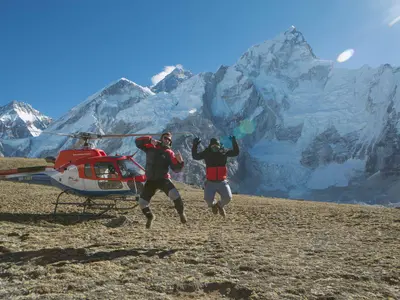
Flying down after walking up carries none of that risk, which is the logic of heli treks in the Everest region that walk up and fly out.
Does age or fitness protect you from altitude sickness?#
No. Fitness does not protect you, and being over 50 does not raise your risk. The CDC Yellow Book states that training and fitness do not affect risk, and that people over 50 have slightly less risk than younger travelers.
The field studies agree. At Pheriche, Hackett found AMS more common in younger trekkers, and its severity fell with age regardless of how fast people had climbed. A 2024 survey of 887 climbers on Mount Fuji also found younger age a risk factor. HoneyGuide routinely runs treks for people over 60 without any issues. One of our senior guests, Ishita, notes that her group reached Base Camp in May 2023 by walking slowly and never pushing past their limits.
Your own history is the best guide, if the altitude and pace were similar. A past episode of moderate to severe AMS puts you in the CDC's medium-risk group, and a past HAPE or HACE in the high-risk group. Tell your doctor and your guide before you go. HoneyGuide asks about altitude history when you first request a trek plan, and builds a slower, custom route for anyone with a past episode, including on the Everest Base Camp Trek.
Should you take Diamox on the Everest Base Camp trek?#
For most trekkers on a standard itinerary, yes, it is worth asking a doctor for acetazolamide (Diamox), because the CDC and the WMS both put this kind of ascent in the group where it should be considered. The CDC's risk table rates more than 500 m a day above 3,000 m, with rest days, as medium risk, and its advice for that group is direct: "Acetazolamide prophylaxis would be beneficial; consider its use."
The prevention dose in both guidelines is 125 mg every 12 hours. Start it the day before the climb begins, and stop once you start descending from your highest point. The treatment dose is 250 mg every 12 hours.
Take it before symptoms appear. It can still help treat mild AMS, which is why the CDC advises even low-risk travelers to carry it.
A sulfa allergy rarely rules it out. The WMS calls the risk of a reaction in people with sulfonamide allergy extremely low. The true contraindications are past anaphylaxis to a sulfonamide drug or Stevens-Johnson syndrome. Expect tingling in the fingers, toes or around the mouth. A 2012 meta-analysis of 24 trials found it increased at every dose. Carbonated drinks may taste flat.
Acetazolamide does not replace a slow ascent, and it does not prevent HAPE.
What else prevents altitude sickness, and what does not work?#
Go high, sleep low; drink to thirst; avoid alcohol for the first 48 hours at altitude and above 4,000 m; eat regular meals; and keep warm.
The WMS states that forced hydration has never been shown to prevent altitude illness and may raise the risk of hyponatremia, or low blood sodium. Hyponatremia can look like AMS, and at altitude it has been mistaken for HACE. The old advice to drink 4 liters a day is out of date. Drink enough to stay out of thirst, and use your urine color as the indicator. You want it to be light yellow.
Lean your diet toward carbohydrates. They raise blood oxygen slightly, and in a randomized trial at 5,192 m, climbers given carbohydrate supplements finished a timed climb 17 percent faster. A high-carbohydrate diet has not been shown to prevent AMS, so treat carbohydrates as fuel, not protection.
Do not take opioids or long-acting benzodiazepines such as diazepam to help you sleep, because they can depress breathing at altitude. If you need a sleeping pill, ask your doctor about acetazolamide or a short-acting option such as zolpidem.
The WMS and CDC list dehydration, exhaustion, low blood sugar, hypothermia and carbon monoxide poisoning among conditions that mimic AMS. Gastritis is another common cause of headache and lost appetite on the trail. A warm hat, a proper meal and a room away from a smoky stove clear several of them.
There are several misconceptions around things that help with AMS. Here are the most commonly cited ones:
- Fitness training does not lower your risk, as the CDC states plainly.
- Slow breathing at about six breaths a minute raises blood oxygen while you do it, but the gain fades within minutes and it has not been shown to prevent AMS.
- Ginkgo biloba did no better than placebo in a trial of 614 trekkers on the approach to Everest Base Camp, and the WMS recommends against it.
- Hypoxic tents at home should not be relied on, the WMS says, because the two controlled studies found no clear drop in AMS.
- Canned oxygen holds only a few liters, too little to prevent or treat AMS, according to both the WMS and the CDC.
What should you do if you get altitude sickness on the trek?#
Stop climbing, score your symptoms on the 2018 Lake Louise AMS score, and let the score and how you feel decide the next step. Above all, never move to a higher altitude with symptoms, however mild they seem. Note that an oximeter reading is not a diagnosis, and it correlates only weakly with AMS and HACE. Only symptoms decide.
The score rates four symptoms from 0 (none) to 3 (severe): headache, stomach upset, fatigue or weakness, and dizziness. A total of 3 or more that includes a headache means AMS. Score after at least 6 hours at a new altitude.
Symptom | 0 | 1 | 2 | 3 |
|---|---|---|---|---|
Headache | None | Mild | Moderate | Severe, incapacitating |
Stomach upset | Good appetite | Poor appetite or nausea | Moderate nausea or vomiting | Severe nausea and vomiting, incapacitating |
Fatigue or weakness | Not tired or weak | Mild | Moderate | Severe, incapacitating |
Dizziness or lightheadedness | None | Mild | Moderate | Severe, incapacitating |
Add the four numbers for a total out of 12.
Score | Severity | What to do |
|---|---|---|
0 to 2 | No AMS, or any total without a headache | Carry on as planned |
3 to 5 | Mild | Go no higher. Rest. Ibuprofen or acetaminophen for the headache |
6 to 9 | Moderate | Go no higher. Get medical advice if you can. Descend if worse, or if no better within 1 to 3 days |
10 to 12 | Severe | Descend |
The WMS notes that the score is a research tool and not a replacement for expert medical assessment. If you are not feeling well or getting worse, go down regardless of what the number says.
This is exactly how HoneyGuide uses it. Our guides record each traveler's SpO₂ and pulse before breakfast and before dinner, and a Lake Louise score every morning above 3,000 m, and HQ in Kathmandu reviews the trend each evening. We use the data purely for as early-warning signals. The earlier we can come to terms with AMS, the more options we have and lower the chances of serious issues later on.
HACE and HAPE skip the score. If someone cannot walk a straight heel-to-toe line, is confused, or is breathless at rest, start down immediately, with a companion. That is the strongest argument against solo trekking to Everest Base Campabove Namche. The WMS says a descent of 300 to 1,000 m usually relieves AMS and HACE. For HAPE it advises at least 1,000 m with as little effort as possible: carried, on a horse or by helicopter.
The Himalayan Rescue Association runs an aid post at Pheriche that gives free daily talks on altitude illness in the trekking seasons. Khunde Hospital sits above Namche, and the Mountain Medical Institute has clinics in Namche and Dingboche.
Sources#
- Luks AM, Beidleman BA, Freer L, et al. Wilderness Medical Society Clinical Practice Guidelines for the Prevention, Diagnosis, and Treatment of Acute Altitude Illness: 2024 Update. Wilderness & Environmental Medicine 35 (2024): 2S to 19S. Ascent rates, acetazolamide dosing, hydration and treatment.
- Hackett PH, Shlim DR. High-Altitude Travel and Altitude Illness. CDC Yellow Book 2026. Risk categories, age and fitness, and the Everest itinerary.
- Roach RC, Hackett PH, Oelz O, et al. The 2018 Lake Louise Acute Mountain Sickness Score. High Altitude Medicine & Biology 19 (2018): 4 to 6. The self-assessment score and its severity bands.
- Hackett PH, Rennie D, Levine HD. The incidence, importance, and prophylaxis of acute mountain sickness. The Lancet 2 (1976): 1149 to 1155. The Pheriche study of 278 trekkers.
- Basnyat B, et al. Everest or bust: a cross sectional, epidemiological study of acute mountain sickness at 4243 meters in the Himalayas (1999). The 1996 Pheriche survey of 550 trekkers.
About the author
Written by
Ashish Shrestha
Founder at HoneyGuide
Born in Kathmandu, Ashish studied neuroscience at the University of Pennsylvania before returning to the mountains he grew up with. An avid trekker and a birder, he has been working the Khumbu since 2015, just long enough that when he recommends a guide or a lodge, he is choosing from people he knows.
All posts by AshishTreks to plan


Ready to go? Compare all our Everest treks & prices
Continue planning your Everest trek
Where to Stay in Kathmandu Before an Everest Trek
If you are taking the 1 am shuttle to Ramechhap, stay in Thamel or Lazimpat a short walk north. If you are flying by helicopter or sleeping in Manthali, choose on logistics and air. Three things about the trek decide this before price or atmosphere does.
Hotels & Lodges · Updated
How to get to Everest Base Camp? Putting together a day-by-day itinerary.
Take a base itinerary and test every day against four things: how much higher you sleep, how far you walk, how you fly, and, if it matters to you, where you sleep. Change anything that doesn’t fit your requirements.
Trek Planning · Updated
Which Everest trek is a good fit for me?
Everest trips come in four kinds: heli tours, short heli treks, classic treks and high pass circuits. The right one is decided first by the days you have, second by how high you are willing to sleep, and third by the pace you can hold.
Trek Planning · Updated
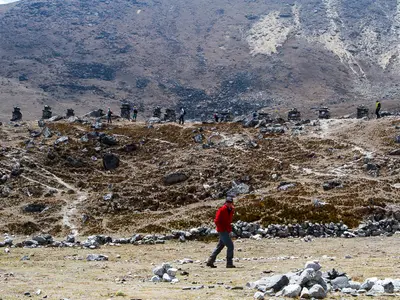
What is HoneyGuide's approach to safety on an Everest trek?
HoneyGuide's approach to safety is to settle most of the risk before you even reach the trail, then run the trail based on data and written protocols. A guided trek is not automatically a safer one, and the research below says so. Does trekking with a travel company actually make an Everest trek safer? Not …
Health & Safety · Updated
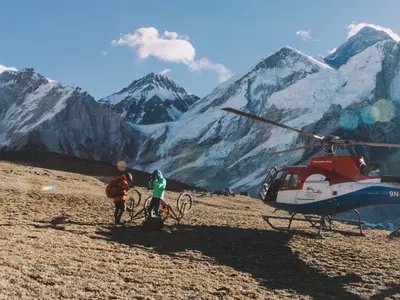
Independent, group, or private: how should you organize your Everest Base Camp trek?
Organizing an Everest Base Camp trek comes down to three questions: how much the plan should bend to fit you, who you want to trek with, and how much you want to spend. The arrangement you choose follows from your answers.
Cost & Booking · Updated
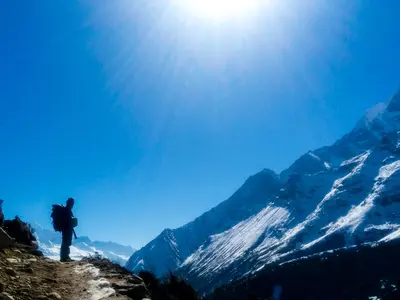
Everest Base Camp Trek- Solo Trekking
If you're concerned about safety and invest your time in planning & research, Trekking solo to the Everest Base Camp can be a very rewarding experience that ensures ultimate solitude, flexibility, and even cost-effectiveness.
Cost & Booking · Updated
Ready to go? Everest Base Camp Trek prices and dates