Where to Stay in Kathmandu Before an Everest Trek
If you are taking the 1 am shuttle to Ramechhap, stay in Thamel or Lazimpat a short walk north. If you are flying by helicopter or sleeping in Manthali, choose on logistics and air. Three things about the trek decide this before price or atmosphere does.
HoneyGuide StaffPublished 6 min read
If you are taking the 1 am shuttle to Ramechhap, stay in Thamel or Lazimpat a short walk north. If you are flying by helicopter or sleeping in Manthali, choose on logistics and air. Three things about the trek decide this before price or atmosphere does.
The first is the flight. In the peak months, Ramechhap to Lukla flights replace the direct departures from Kathmandu. Manthali Airport is a four- to five-hour drive east, and the shared shuttle leaves Thamel at about 1 am. Every kilometer between your bed and Thamel comes out of the few hours of sleep you were going to get.
The second is logistics. If you have a long list of gear to buy or rent, stay close to Thamel. The third is the air quality, which matters from December to May and has its own section below.
Treat the night before the trek as logistics and the nights after it as yours. They are different stays, and they can be different hotels.
How do Thamel, Lazimpat, Naxal, Patan, Boudha and Jhamsikhel compare for trekkers?#
Thamel wins on logistics and loses on sleep. Lazimpat and Naxal give up little of the first for a good deal of the second.
Neighborhood | To the Thamel shuttle pickup | To the airport | Trek shops | Noise | Best for |
|---|---|---|---|---|---|
Thamel | On the doorstep | 7 km · 20 to 30 min | The best in Nepal | Loud and busy day and night | Gear errands and the easiest shuttle |
Lazimpat | 5 min walk | 7 km · 20 to 30 min | Limited, Thamel close by | Quiet, leafy, embassy streets | A calmer bed within walking distance of Thamel |
Naxal | 2.2 km · short taxi | 5 km · 15 to 20 min | Minimal | Calm, residential | A quiet central stay, close to the airport |
Old Patan | 7 km · about 30 min taxi | 7 km · 25 to 40 min | Virtually none | Gentle buzz around the Durbar Square | Culture, if you do not mind the distance |
Boudha | 8 km · some shuttles pick up here | 5 km · 15 to 30 min | Limited | Monastery bells and pilgrims | A quiet, meditative stay |
Jhamsikhel | 7 km · taxi needed | 8.5 km · 25 to 40 min | None | Relaxed, cafes and families | Longer stays |
Thamel has shops, pharmacies and rental stalls on nearly every lane, which matters the day before a trek when something is missing. It is also the loudest place you will sleep in Nepal.
Does the Ramechhap flight change where you should sleep?#
Yes, but only if you take the 1 am shuttle. In autumn 2025 the Civil Aviation Authority of Nepal moved Lukla flights from Kathmandu to Manthali Airport in Ramechhap from September 25 for the peak season. The dates change from year to year. During the diversion, the shared shuttle leaves Thamel at about 1 am for a four- to five-hour drive. From Patan or Jhamsikhel, add a 30-minute taxi to reach it.
A private transfer changes this. On HoneyGuide's Everest Base Camp Trek, when flights go from Manthali, the drive to Ramechhap is a private transfer rather than the shared shuttle, so the vehicle comes to your hotel instead of you going to Thamel.
Outside the diversion, fixed-wing flights to Lukla leave Tribhuvan International Airport around 6 am. Naxal and Boudha, about 5 km from the airport, then give the shortest ride.
Two options remove the night drive altogether. A shared helicopter from Kathmandu to Lukla takes about 45 minutes and costs roughly USD 500 to 600 a seat. Or drive to Manthali the afternoon before and sleep there, for around USD 30 to 50 a night. Either way the Thamel pickup stops mattering as much. The trade-offs between the three routes are laid out in the post on how to get to Lukla.
Does Kathmandu's air pollution affect where you should stay?#
From December to May, yes. The cleanest air near Kathmandu is above the valley floor, in hotels sited higher than about 1,500 m on the valley rim.
The valley floor sits at about 1,300 m, in a bowl ringed by hills of 1,900 to 2,800 m. On winter nights and mornings, cold air settles into it and traps pollution close to the ground. At Bode, near the valley center at 1,344 m, the layer in which pollution mixes measured about 200 m deep at night and about 1,200 m by day, according to a 2018 study in Atmospheric Chemistry and Physics. That puts the top of the nighttime layer at around 1,500 m. The same study found that ridge sites generally sat above it at night: carbon monoxide at the Nagarkot ridge site, at 1,901 m, averaged about 240 parts per billion against about 570 at Bode.
The season matters as much as the altitude. At Ratna Park in central Kathmandu, close to Thamel, monitoring from 2021 to 2023 found fine-particle pollution highest before the monsoon, March to May, at a seasonal mean of 60.6 μg/m³, followed by winter at 52.5. January's monthly mean reached 95.8. Levels drop in the monsoon and stay lower through October and November, so autumn trekkers are the least affected.
The rim is not clean air in every sense. Ozone arrives on regional winds, and ridge sites get more of it. Nagarkot exceeded the WHO eight-hour ozone guideline of 50 ppb on 45 percent of days, against 29 percent at Bode, most of them before the monsoon.
Budhanilkantha, at the foot of Shivapuri Nagarjun National Park on the valley's northern edge, is the closest rim option to the city. Hotels there include Park Village, Holiday Inn Resort and Lemon Tree.
Should you stay somewhere different after the trek?#
Usually, yes. Once the trek is over you no longer need Thamel's shops or its 1 am pickup, so stay where you will rest.
Book the return nights with changeable dates. They double as buffer, and a Lukla weather delay can move them.
Patan puts you beside Patan Durbar Square and the Patan Museum, with heritage hotels and guesthouses in the old city. Boudha puts you beside the largest stupa in Nepal, with monastery guesthouses and mid-range hotels. In winter or spring, the hotels for hiking around Kathmandu on the valley rim add forest walks to better air. If there is one night to spend money on in Kathmandu, it is this one, in a heritage hotel.
What kind of hotel should you book, and what does it cost?#
A mid-range hotel at USD 40 to 90 a night covers everything a trekker needs. Above that, you are buying comfort rather than function.
Type | Examples | Per night |
|---|---|---|
International brands | Marriott, Aloft, Soaltee (Autograph Collection), Dusit, Holiday Inn, Mercure, Lemon Tree, Fairfield, Ramada, Radisson | USD 150 to 250 |
Nepali five-star | Yak & Yeti, Malla, Everest, Himalaya, Basera, Gokarna Forest Resort | USD 150 to 200 |
Heritage | Dwarika's, Baber Mahal Vilas, Thamel Villa, Kantipur Temple House, Swotha Homes, Hotel Shanker | USD 80 to 400 |
Mid-range, three to four star | Marshyangdi, Manang, Barahi Kathmandu | USD 40 to 90 |
Wellness retreats and resorts | Park Village, Holiday Inn Resort, Terraces, Chandragiri Hills | USD 100 to 600 |
Airbnb and homestays | Around the Kathmandu and Patan Durbar Squares, Baluwatar and Lazimpat | USD 30 to 120 |
Monastery guesthouses | Boudha | USD 30 to 100 |
Budget hotels | Thamel and Boudha | USD 15 to 35 |
Hostels | Mostly Thamel | USD 8 to 15 |
At the budget end, quality varies more than price. Read recent reviews and confirm hot water and WiFi before you pay.
What should you confirm with the hotel before you book?#
Five things, all about the trek rather than the room.
- 24-hour reception, with your room held for a midnight arrival.
- Free luggage storage for the full length of the trek. Your city clothes stay behind while the duffel goes to Lukla.
- A packed or very early breakfast on flight day.
- Changeable dates. A Lukla delay turns buffer days into extra Kathmandu nights, sometimes at short notice.
- Parking for pickups. Many hotels, even in Thamel, have no parking for a pickup vehicle.
Sources#
- Mahata KS, Rupakheti M, Panday AK, et al. Observation and analysis of spatiotemporal characteristics of surface ozone and carbon monoxide at multiple sites in the Kathmandu Valley, Nepal. Atmospheric Chemistry and Physics18 (2018): 14113 to 14132. The night-time mixing layer, the ridge sites above it, and the ozone caveat.
- Mahapatra PS, Praveen PS, Adhikary B, et al. Air quality trends of the Kathmandu Valley: a satellite, observation and modeling perspective. Atmospheric Environment 201 (2019): 334 to 347. How the bowl and the winter inversion trap pollution at the valley base.
- Air quality and meteorological drivers in Kathmandu Valley, Nepal: a 2021 to 2023 observational study. Ratna Park and Kirtipur monitoring, and the seasonal fine-particle figures.
About the author
Written by
HoneyGuide Staff
HoneyGuide is a Nepal-based trekking company. These posts are written by the guides and trip planners who work the routes they describe — mostly in the Everest region — and are updated as trails, permits and lodges change.
All posts by HoneyGuideReady to go? Compare all our Everest treks & prices
Continue planning your Everest trek
How to get to Everest Base Camp? Putting together a day-by-day itinerary.
Take a base itinerary and test every day against four things: how much higher you sleep, how far you walk, how you fly, and, if it matters to you, where you sleep. Change anything that doesn’t fit your requirements.
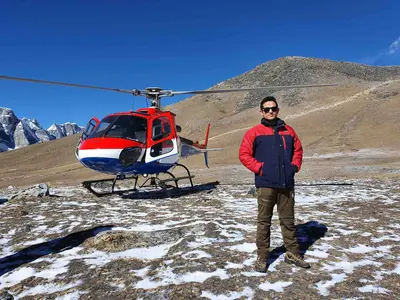
Heli Treks in Everest Region
Helicopter treks merge the immersive experience of walking with the birds-eye view of helicopter tours. The result is that you will be able to experience more in less time.
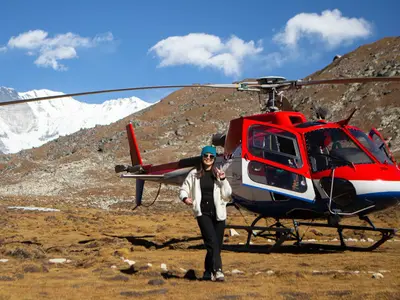
Helicopter Tours in the Everest Region
For those pressed for time or with an aversion for high-altitude labor, a helicopter tour can be the perfect way to experience the best that Everest has to offer.
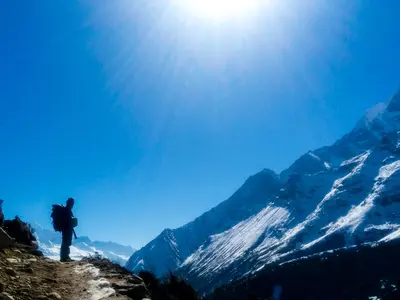
Everest Base Camp Trek- Solo Trekking
If you're concerned about safety and invest your time in planning & research, Trekking solo to the Everest Base Camp can be a very rewarding experience that ensures ultimate solitude, flexibility, and even cost-effectiveness.
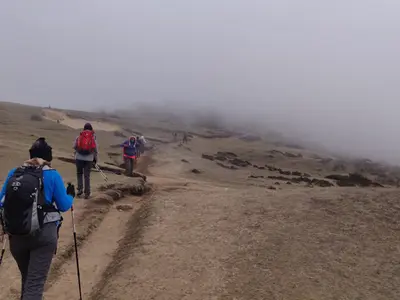
How to Hire a Trekking Guide for Everest Base Camp Trek?
Hiring a trekking guide for Everest Base Camp trek is safe, cost-efficient and flexible way of making the most of the trek. A good guide will help you understand the land and mountains better, get in the permits line for you, ensure safety and handle the emergency situations as well. Trekking Guide Vs. Porter-Guide Vs. …
An Independent Trekker's Guide To Everest Base Camp
Your guide to the right information, lodge/flight booking to trek independently to the Everest Base Camp.