HoneyGuide’s approach to safety is to settle most of the risk before you even reach the trail, then run the trail based on data and written protocols. A guided trek is not automatically a safer one, and the research below says so.
Does trekking with a travel company actually make an Everest trek safer?
Not by itself. The published evidence from Nepal points the other way more often than the trekking industry admits.
Shlim and Gallie reviewed trekking deaths in Nepal from mid-1987 through 1991 for the International Journal of Sports Medicine. They recorded 40 deaths among 275,950 trekkers, 10 of them from altitude illness. Eight of those 10 died in organized groups, although only 40 percent of trekkers were in organized groups.
In a 2022 survey of 366 trekkers on the Everest Base Camp trail, Carina Cerfontaine, Thomas Küpper and colleagues at RWTH Aachen found acute mountain sickness (AMS) symptoms in 55 percent of trekkers on commercially organized trips and 40 percent of those who organized their own. They treat that gap as a tendency rather than proof, and independent trekkers had more medical incidents overall. The authors suggest the cause is the fixed schedule of an organized trek. The trekker who feels unwell does not want to slow the group, and the operator has every reason to keep to the plan. The sharper finding, however, is that four of the five trekking companies their respondents named most often ran altitude profiles that broke the UIAA’s acclimatization recommendations.
A company makes you safer only when it is willing to lose time and money on your behalf. Five questions show whether it will: how the itinerary was built, how fast the route climbs, what number stops the ascent, who decides what happens next, and who gets paid if you are evacuated.
How does HoneyGuide build the route so altitude illness is less likely?
We build the route around three things before dates, deposits or a guide are fixed: a ceiling on sleeping-altitude gain, your medical history, and your pace. Most default itineraries, including ours, go over the Wilderness Medical Society’s (WMS) 2024 limit of 500 m (1,640 ft) of sleeping-altitude gain a night above 3,000 m (9,840 ft).
We treat 500 m as a ceiling, not a target. Both WMS and CDC link a slower ascent with less altitude illness, and the UIAA’s medical commission recommends 300 to 500 m (980 to 1,640 ft) a night from 2,500 m (8,200 ft). For travelers with a history of altitude illness, or who ask for a gentler pace, we split stages to plan closer to 300 to 400 m (980 to 1,310 ft) a night.
The route is then fitted to you through an Altitude-Aware Pre-Screening. A history of high-altitude cerebral edema (HACE), high-altitude pulmonary edema (HAPE) or moderate to severe AMS, or never having slept above 4,000 m (13,120 ft) changes the route rather than the paperwork. For a few medical conditions the safe sleeping altitude sits below the top of the trek, whatever your fitness.
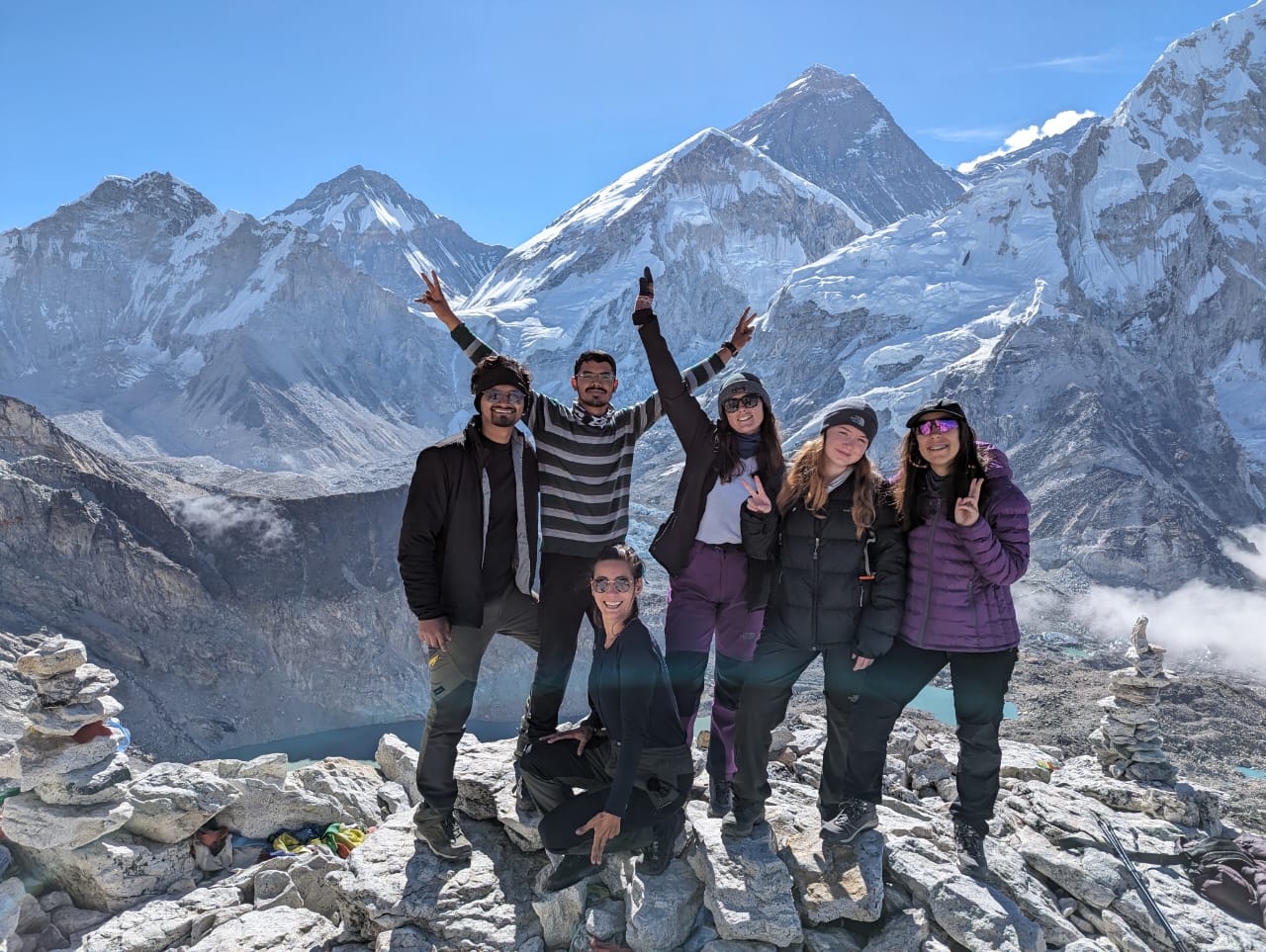
Most important, as HoneyGuide specializes in tailor-made private treks in the Everest Region, we can adapt the route to how your group is feeling on the trail itself. For example, one of our guests, Sam K, who reached Base Camp with a cousin in November 2022, wrote on TripAdvisor that their guide, Pasang Sherpa, “adjusted [the] trek to allow more rest,” and that the two had minimal trouble with the altitude as a result.
Which day on the Everest Base Camp trek gains the most altitude?
Dingboche to Lobuche, which gains at least 590 m (1,940 ft) in a single day, not the 530 m most itineraries show.
The 530 m figure comes from the altitude usually given for Dingboche, 4,410 m (14,469 ft), subtracted from Lobuche at 4,940 m (16,207 ft). Checked against Google Earth and the Survey Department of Nepal’s topographic maps, Dingboche sits lower, at about 4,300 to 4,350 m (14,110 to 14,270 ft). That puts the day at least 90 m over the 500 m (1,640 ft) ceiling the Wilderness Medical Society and the CDC set, on the night you first sleep near 5,000 m (16,400 ft).
The acclimatization hike to the top of Nangkartshang Peak, 5,083 m (16,676 ft), on the extra day at Dingboche helps, but it does not change how high you sleep the next night. Splitting the day does. Thukla, at 4,620 m (15,157 ft), is 4.8 km (3 mi) and about three hours from Dingboche, which cuts the gain to roughly 300 m (980 ft) on each of the two days. The teahouses at Thukla are very basic, and the split adds a day to your trek. The two shorter days leave room for a side trip to Chola Lake (Tshola Tsho) on the first, and to the quiet side valley with the Pyramid High Altitude Science station on the second.
The same correction applies one day earlier. Deboche is usually given as 3,820 m (12,533 ft) but sits closer to 3,720 m (12,205 ft), which makes the walk to Dingboche a gain of about 600 m (1,970 ft). The standard second night at Dingboche usually absorbs it. However, if you have a history of altitude illness there are two gentler options: sleep at Tengboche, 3,860 m (12,664 ft), instead of Deboche, or continue from Deboche to Pangboche, 4,020 m (13,189 ft), with a side trip to Ama Dablam Base Camp at about 4,600 m (15,090 ft).
Most standard itineraries skip Thukla and Pangboche as overnight stops for a simple reason. They save a day, and for an itinerary built around the average trekker, the day saved counts for more than the risk reduced. We lay out the gain and the options, and the choice is yours. Our own view is that the average is a poor basis for planning a once-in-a-lifetime experience.

What has to happen before you fly to Lukla?
Eleven gates have to close, in order, and nobody leaves Kathmandu with one still open.
| Gate | When | What closes it |
|---|---|---|
| Altitude-Aware Pre-Screening | When you request a plan | Medical details that steer the route |
| Medical disclosure | At booking | Medical history on the booking form |
| Physician clearance | At booking, certain conditions only | Clearance for higher-risk conditions |
| Trek prep session | Four months before | Plan across meditation, yoga, corrective work, strength and cardio |
| Guide confirmation | Three to two months before | Video call with your guide; you can ask for another |
| Packing list session | Two months before | Every item checked against weather and hazards |
| Health and safety session | One month before | Altitude illness, acclimatization, food and water, vaccines, insurance |
| Insurance selection | 20 days before | Cover that includes high-altitude trekking and helicopter evacuation |
| Insurance and emergency details | 10 days before | Policy details collected, emergency contact briefed |
| Gear verification | On arrival in Kathmandu | Gear checked, gaps rented or bought |
| Pre-departure briefing | On arrival in Kathmandu | Traveler Booklet walked through |
The sessions are one-on-one video calls, not documents sent by email, and Ashish takes the pre-departure briefing himself.
The gate travelers underuse is guide confirmation. It is the one point where you meet the person who will read your oximeter at Lobuche, and can still ask for someone else. What to look for is covered in how to hire a trekking guide for the EBC trek.
What does your guide record on the trail every day?
Your guide measures your blood oxygen saturation (SpO2) and pulse twice a day and scores you for acute mountain sickness (AMS) every morning. They then send the measurements to us in Kathmandu where we chart it out and flag any issues early.
Oximeter readings start in Kathmandu, before breakfast and before dinner. Above 3,000 m (9,840 ft) you and your guide also complete the 2018 Lake Louise AMS score each morning, rating headache, stomach, fatigue and dizziness from 0 to 3. Both are logged in your booklet and uploaded to HQ, which checks the trend each evening and sends weather and advice back to the lead guide.
The trend against your own baseline matters more than the number on the screen, because saturation falls for everyone as they climb. The warning signs are a reading 9 percent or more below the reference for that altitude, a drop between two nights at the same altitude, and a morning reading lower than the previous evening one.
However, symptoms outrank SpO2 readings. Writing in Wilderness & Environmental Medicine in 2012, Jeremy Windsor and Ken Zafren both concluded that a pulse oximeter is a poor tool for predicting who will develop acute mountain sickness.
What happens if you get altitude sickness, and who decides what?
A written escalation ladder with numeric triggers sets the response, and each decision has a named owner.
| Level | Trigger | What happens |
|---|---|---|
| Monitor | AMS score 0 to 2, SpO2 within 3 percent of baseline | Continue as planned |
| Hold | AMS score 3 to 5, SpO2 3 to 6 percent below baseline, or morning reading below evening before | Stop ascending and treat symptoms. Continue once the AMS score is 2 or less for 24 hours |
| Respond | AMS score 6 to 9, SpO2 6 to 9 percent below baseline, a drop at the same altitude, or major trauma | Stop ascending. Oxygen, medication and local medical help, and possibly an accompanied descent of 300 m (980 ft) or more |
| Evacuate | AMS score 10 to 12, SpO2 9 to 15 percent below baseline, HACE, HAPE or major trauma | Immediate medical attention, stabilization and evacuation |
The ladder follows the rule the Wilderness Medical Society and the CDC Yellow Book both give: do not go higher with symptoms, and go down if they get worse.
| Decision | Who makes it |
|---|---|
| Hold / Respond | The lead guide and HQ. HQ can upgrade the guide’s call, and the guide can escalate without waiting for HQ in a critical case |
| Evacuate | Your insurer and the field physician, usually with HQ. In a life-threatening case the lead guide can start it alone, and dispatch does not wait for insurance approval |
| Which re-ascend option to take | You |
Does getting sick on the trek mean the trek is over?
Rarely. Between carrying on as planned and abandoning the trek there are four documented options, and you choose among them once the medical picture allows.
| Option | Example | Cost to you |
|---|---|---|
| Add days | An extra night at Dingboche, then continue once the AMS score clears | Extra days, limited extra cost |
| Rework the itinerary | Descend from Lobuche to Pheriche, re-ascend to Lobuche, visit Base Camp or Kala Patthar, return to Lobuche | May keep your return date, some experiences may be compromised |
| Heli assist | Descend from Lobuche to Pheriche, then fly to Kala Patthar and back to Lukla | Usually keeps the highlights and the return date, the helicopter cost is extra |
| Split the group | An assistant guide stays with you while the group continues, with a plan to rejoin | Shared days lost, extra staff cost to you |
Splitting a group only works if there is a spare guide on the mountain. We staff at one guide for every three trekkers, which is what makes the last row real rather than theoretical. Each trek also has a single point of contact from the first email to the flight home, so the person laying out these options already knows your medical history, your return date and your guide.

How do you know you are not being set up for a helicopter rescue?
Because, HoneyGuide has had only 8 evacuations in total as of August 2026. And we have run treks for around 2,500 travelers since 2018. This is because for us your safety comes above everything else and we do not subscribe to the system that accepts commissions from helicopter operators and hospitals.
We understand your fear around the fake-evacuation scam. In 2026, Nepal Police’s Central Investigation Bureau brought organized crime and fraud charges in the Kathmandu District Court against 32 people, among them trekking agency owners, helicopter operators and hospital executives. Prosecutors allege staged evacuations, forged medical and flight records, and fraudulent insurance claims close to USD 19.7 million between 2022 and 2025. Investigators describe hospitals passing a share of insurance payments back to the trekking companies that referred the patients.
You can read more about how not to be part of the scam in our Travel Insurance page. For now, here are our anti-fraud commitments, from our Safety and Evacuation Protocol:
- We accept no commission, kickback or referral fee from any helicopter operator, hospital or clinic.
- We trigger an evacuation only on the criteria in the Evacuate row above, and only with pre-authorization under your Everest Base Camp travel insurance, unless a life is at risk.
- Every helicopter and medical invoice is itemized, and the originals go to you for your claim.
- We decline helicopter evacuations that are not medically indicated. A staged rescue puts your claim at risk, follows you to your next insurer, and ties up an aircraft someone else may need.
Sources
- Luks AM, Beidleman BA, Freer L, et al. Wilderness Medical Society Clinical Practice Guidelines for the Prevention, Diagnosis, and Treatment of Acute Altitude Illness: 2024 Update. Wilderness & Environmental Medicine 2024. The 500 m sleeping-altitude ceiling and rest-day cadence every route in this post is built to.
- CDC Yellow Book. High-Altitude Travel and Altitude Illness. The same ascent limits written for travelers and their doctors, and the best single page to read before a pre-trip medical appointment.
- Shlim DR, Gallie J. The causes of death among trekkers in Nepal. International Journal of Sports Medicine1992;13 Suppl 1:S74-76. The review behind the finding that most altitude deaths occurred in organized groups.
- Cerfontaine C, Küpper T, et al. Companion Rescue and Risk Management of Trekkers on the Everest Trek, Solo Khumbu Region, Nepal. International Journal of Environmental Research and Public Health 2022;19(23):16288. The 366-trekker EBC survey, including its finding on operators’ altitude profiles.
- The Kathmandu Post. Inside Nepal’s fake rescue racket. March 27, 2026. The clearest account of how the rescue-fraud case developed from the 2018 inquiry to the 2026 charges.