How do you avoid and handle a serious injury on the Everest Base Camp trek?
Serious injuries are rare on the Everest Base Camp trek, but when one happens, a hospital is hours away and a helicopter needs clear weather to reach you. So the job has two halves: avoid the fall in the first place, and keep an injured person stable until help can land.
HoneyGuide StaffPublished 7 min read
Serious injuries are rare on the Everest Base Camp trek, but when one happens, a hospital is hours away and a helicopter needs clear weather to reach you. So the job has two halves: avoid the fall in the first place, and keep an injured person stable until help can land.
Where on the Everest Base Camp trail do people get hurt?#
People get hurt on ordinary ground as well as steep ground, and the hazards sit in a handful of known places. On May 4, 2026, an experienced Nepali guide died in a fall between Gorakshep and Base Camp, on moraine with no exposed sections, according to The Himalayan Times and Explorersweb.
The table below is drawn from HoneyGuide's route database, which records the hazards on every section of the Everest trails. These are the entries for the way up to Base Camp.
Trail section | Hazard | What to do |
|---|---|---|
Lukla to Chheplung | First morning on the trail, pack animals, legs tired from travel | Walk slowly and keep to the mountain side |
Jorsalle to Namche Bazaar | Yak and mule trains on the suspension bridges, and about 700 m (2,300 ft) of climb | Wait for a train to cross before you start. Step to the wall side, never the drop side |
Namche to Kyanjuma | Occasional rockfall on the contour path | Keep your ears free and do not stop below loose slopes |
Tengboche to Deboche | The trail stays icy long after snowfall | Wear microspikes after any snowfall |
Nangkartshang, above Dingboche | Steep, and the ground drops away without warning at the prayer flags | Skip it when wet or snowy. Stay back from the flags |
Gorakshep to Base Camp | The route across the glacier shifts every season | Follow a guided group, especially after fresh snow |
Gorakshep to Kala Patthar | Snow on the rock, and the coldest pre-dawn start of the trek | Go very slowly when snow covers the rock |
The walk out is where knees and ankles give. Below Namche the trail drops more than 600 m (1,970 ft) to the river at Jorsalle. Take it in short, measured steps, and do not run it.
How do you avoid falls and pack animals on the trail?#
Stand on the mountain side when yaks or mules pass, watch your feet rather than the view while you are moving, and use two poles on the long descents.
The other rules follow from the same idea:
- Be deliberate with your feet for the first two days. This is when fatigue and unfamiliarity overlap. Slow down and watch your placement rather than the scenery while you are moving.
- Do not climb onto rocks or ledges above a drop for a photo. The Ama Dablam backdrop is not worth the exposure. Keep both feet on stable, level ground for pictures.
- If you lose the trail, go back to where you left it. The right path is usually a few meters above or below you, and scrambling across loose ground to reach it is how people fall.
- Do not wear headphones while walking. You often hear rockfall before you see it.
- Do not walk alone. An injury with nobody to help or raise the alarm is the worst case.
- Arrive fit and warmed up. Pre-trek conditioning and trekking poles both cut fall and injury risk, and a few minutes of loosening up before you start the day helps. See how to prepare for the EBC trek.
The UIAA Medical Commission recommends poles for downhill walking, especially for older trekkers, anyone with joint problems and anyone carrying a load, and notes that two poles improve balance under a load. The same paper warns that poles planted too far from the body can throw you off balance, and that they get in the way on narrow or rocky ground, where they belong strapped to your pack.
What should you do in the first minutes after a serious injury?#
Work in a fixed order: get clear of the danger, stop heavy bleeding, check breathing, then keep the person flat and warm.
- Get clear. Move yourself and the injured person away from rockfall, a loose slope or a passing yak train first. If the spot is safe, the 2024 American Heart Association and American Red Cross first aid guidelines say someone who may have hurt their neck, back, hip or pelvis should stay where they were found.
- Stop heavy bleeding. Press hard and directly on the wound with gauze, a gloved hand or folded clothing, and keep pressing. For life-threatening bleeding that pressure does not stop, the same guidelines call for a tourniquet, or for packing the wound firmly with gauze where a tourniquet will not fit. The American Red Cross places a tourniquet 5 to 8 cm (2 to 3 in) above the wound, never on a joint, and says not to loosen it once it is on. Write down the time you applied it.
- Check breathing. Once bleeding is controlled, check that the person responds and is breathing. If they are not breathing, start CPR.
- Keep them flat and warm. After heavy bleeding, watch for shock: pale or sweaty skin, weakness, a weak pulse, dizziness and confusion. Suspect bleeding inside the body when those signs appear and little blood is showing. Lay the person on their back. Do not raise the legs. The AHA and Red Cross advise raising them only when there is no injury, as in simple fainting. Put a sleeping mat or pack under them and jackets over them, because the guidelines also call for protecting an injured person from the cold and insulating them from the ground.
How do you treat sprains, cuts, fractures and a possible spine injury until help arrives?#
Flush and cover wounds, splint anything that might be broken, and limit movement of the spine rather than strapping someone down.
Cuts. Once bleeding is under control, irrigate the wound early with drinking-quality water. The Wilderness Medical Society's wound guidelines rate potable water as the preferred fluid and say nothing should be added to it or put into the wound, because antiseptics damage tissue. A syringe, or a clean plastic bag with a pinhole, gives enough pressure to flush out grit. Cover the wound with a clean dressing and leave closing it to a clinic.
Sprains. A bad sprain and a fracture can feel the same without an X-ray. For a mild sprain, the Merck Manual advises protection, rest, ice, compression and elevation. If the person cannot walk on it, or the joint looks deformed, treat it as a fracture and splint it.
Fractures. You do not need to confirm a break to treat it. Splint the limb so the joints above and below the injury cannot move, using trekking poles or a rolled sleeping mat, padded and taped. Then check the fingers or toes beyond it. If they turn pale, cold or numb, loosen the splint. If bone has come through the skin, cover the wound, splint the limb as it lies and do not push the bone back in.
Spine. The Wilderness Medical Society's 2024 guidance moves away from rigid collars and boards toward limiting movement: padding, and asking a conscious person not to move in any way that hurts. Emergency protocols clear the spine only when a person is fully alert, not intoxicated, has no pain in the midline of the neck or back, no numbness or weakness in the limbs and no other painful injury pulling their attention. Some US county protocols add an age limit, such as 55 in San Mateo County, above which they restrict movement anyway. For most readers of this post, that means keeping the spine still after any real fall.
How long does help take to reach you above Namche?#
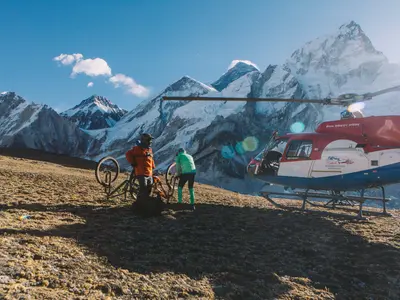
If the weather allows, within the hour. A lot of helicopters are based at Lukla during high season and prioritize emergencies above other flights.
What exists on the trail is basic. Khunde Hospital has 15 beds. The Himalayan Rescue Association runs an aid post at Pheriche, 4,250 m (13,940 ft), staffed by volunteer doctors in the spring and autumn seasons, and has run the Everest ER clinic at Base Camp every spring since 2003.
Two things you control shorten the rescue. Write your insurer's 24-hour emergency number and your policy number on paper, and give a copy to your guide before the trek starts. The post on Everest Base Camp travel insurance covers what the policy itself needs.
Then choose a guide who can start the call without you. Under HoneyGuide's Safety and Evacuation Protocol, a Lead Guide can start an evacuation for life-threatening trauma without waiting for sign-off from our office, and the helicopter is not held back while insurance pre-authorization is sorted out. Our Lead Guides have also completed Wilderness First Aid training within the last three years, with a refresher before every season.
Sources#
- van der Giet M, et al. Inpatient treatment of trekkers and Nepalese workers in the high-altitude environment of Mt. Everest Region 1996-2011. Travel Medicine and Infectious Disease 2019. Fifteen years of admissions at Khunde Hospital.
- Hewett Brumberg EK, Douma MJ, et al. 2024 American Heart Association and American Red Cross Guidelines for First Aid. Circulation 2024;150:e519. Bleeding control, positioning and shock, free to read in full.
- Hawkins SC, et al. Wilderness Medical Society Clinical Practice Guidelines for Spinal Cord Protection: 2024 Update. Wilderness & Environmental Medicine 2024. Why limiting movement has replaced rigid immobilization.
- Quinn RH, Wedmore I, Johnson E, et al. Wilderness Medical Society Practice Guidelines for Basic Wound Management in the Austere Environment. Wilderness & Environmental Medicine 2014;25(3):295-310. Irrigation, dressing and closure far from a clinic.
About the author
Written by
HoneyGuide Staff
HoneyGuide is a Nepal-based trekking company. These posts are written by the guides and trip planners who work the routes they describe — mostly in the Everest region — and are updated as trails, permits and lodges change.
All posts by HoneyGuideReady to go? Compare all our Everest treks & prices
Continue planning your Everest trek
How do you avoid a stomach bug and stay fueled on the Everest Base Camp trek?
Boiled water, freshly cooked carb-rich food and soap go a long way toward preventing traveler's diarrhea and balancing the daily calorie count.
Health & Safety
How to prevent blisters, sunburn, Khumbu cough, and other environmental hazards in the Everest Region?
Environmental hazards are the most preventable risks on the Everest Base Camp trek, because nearly every one is answered by something you pack or a habit you keep. The ones most trekkers meet are the Khumbu cough, blisters and sunburn.
Health & Safety · Updated
How do you use a pulse oximeter on the Everest Base Camp trek?
Clip it on a warm finger after five minutes sitting still, read it before breakfast and before dinner from Kathmandu onward, and compare each reading with your own last few days.
Health & Safety · Updated
Helicopter Tours in Nepal- Traveler Briefing
Knowing what to expect will help you get the most out of your helicopter tour
Gear & Preparation
Tengboche Monastery: The holiest place in Everest
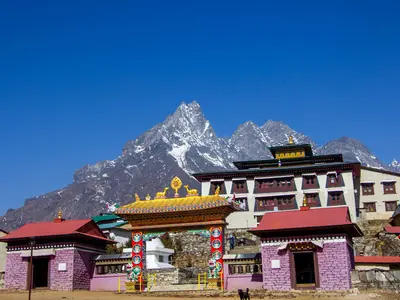
Tengboche monastery is the largest monastery in the Everest Region. If you plan to go, make sure you separate at least 1 hour to go around.
Attractions
Rhododendrons and Other Flora of Mount Everest Region
In addition to stunning mountain scenery, the Everest Region also has some amazing flowers. Here are the top fifteen rhododendrons and other flowers you might see when you do the Everest Base Camp Trek. However, before we start the list, it might help you to know that the best time to visit Everest Base Camp …
Attractions