How I found Yab-Yum in Mustang -Trekking Tales
Gurusampo a unique and beautiful cave, not too far from Tukuche in Mustang in the Annapurna Circuit Trek. This is our experience from our visit to the Cave!
Ashish ShresthaUpdated First published 6 min read
There is this amazing cave called Gurusampo not too far from Tukuche in Mustang. Although only a few hours from the main trail of the Annapurna Circuit Trek, very few people go there. And perhaps it is better that way, for the place is absolutely beautiful. The panorama seen from the trail is unrivaled for at least a fifty kilometers up and down the Kali Gandaki and if it is late spring, you will see one off flowers that are hard to come by in other places. But that is not why I am going to talk about that place today. I am going to talk about this place for my now ex-wife Mamita, and I had one of the most memorable experiences here. And no it isn’t kinky.
About two years ago when my wife and I were collecting data for HoneyGuide, there were talks of a great Lama from Sikkim who was staying at the Gurusampo cave. He could reportedly see the future and many a lodge owners vouched for his clairvoyance. Some even claimed that his words had made them burst into tears from revelation. Also, the outwardly driven would note that the Chief Minister of Sikkim had come to pay the Lama a visit only a few weeks earlier. Growing up in Nepal, you hear such hyperbole about godmen much too often to take it seriously. We decided to visit the cave nevertheless not for the Lama but the view and the flowers.
The day was overcast and rain clouds enveloped the mighty Dhaulagiri. Once in awhile the Ice Fall would peek out from the clouds. But the flowers. The flowers made up for the view ten fold over. Having navigated through fields of Himalayan Asters liberally dotted with louseworts, we reached a stream. Unlike the year before there was a small wooden bridge there and some people were working to repair the bridge. To make a conversation, I asked them about the Sikkim Lama.
They looked mildly puzzled for a bit and then one of them said, “Yes that would be me. Haha. I know nobody recognizes me. Haha. Everybody thinks I am this old serious bearded guy, sitting in a dead serious meditative posture all the time. Haha. But that is so not me. I need to get my hands dirty. What are you doing here?”. He would talk very fast and was very very expressive to say the least. And he had a quirky habit of ending each sentence with a short burst of “Haha”. He was at once disarming and queer.
We said we had come to see the place and that we were writing about Mustang.
He laughed very hard and that laughter continued long enough to make us feel a bit insulted. He then asked, “Do you think you are qualified to write about this place?? Do you even understand what this place is about?? Hahaha. You come here take some pictures, look but don’t see, and leave as fast as you come and then you will write about it?? What will you write when you yourself do not understand the place. Why will people come to this place if you cannot communicate the true meaning of this place to them?? Have you been here before?”
Taken aback, I said a bit defensively, “Yes twice.”
“So tell me what you understand?”
I fumbled for words.
He laughed hard again and said, “Go up and this time actually touch every part of the cave and feel the water and tell me what you think, only then will I consider you guys capable enough to write about this place. Only then will I talk to you.”
I replied a bit haughtily, “Okay I will do it.”
I visited and revisited the cave and the waterfall in my mind as we made our way up. I remember it was just before we reached the cave that I had the answer.
When the Lama came up I explained that the cave was a metaphor for the masculine and feminine forces in the world, the rocky walls of the cave was the male force while the water that flowed was the female force. And the weird lifeforms that grew there was the result of the meeting of this masculine and feminine force.
He smiled. That was a first. He then continued, “Yes that is correct, this is Yab-Yum. Come, I will show you.” He then led me to the entry of the cave and said, “Here touch here what does this feel like, Hahahaha. Doesn’t it feel like a woman’s part? Hahaha. Don’t be ashamed, people who understand should not be ashamed of things like this.” A little embarrassed, I looked around for my wife. Thankfully she couldn’t hear the conversation. The Lama continued, “Now look inside the cave, yes, yes, come here and look, what do you see?? What does it look like! Haha.”
With that he gave us a tour of the cave complex, putting on a layer of meaning on top of each of the rock formations in the area. What would otherwise have been just random formations of nature, now took on a layer of meaning and esoteric as it might sound, the place now suddenly made sense. I still remember one thing that he showed us in the cave as though it were yesterday. An opening in a rock had resulted in a formation that could very well have been a world on its own with lakes, forests, and hills. He asked us what it was to which Mamita had replied, “Oh it is a world inside a world.” At this, he jumped clapping and exclaimed, “Yes that’s it. It is a tortoise that is holding a world on its back. Good very good.” He then said, “You guys are good. You are good enough to write about the place now. You will be successful” While all that event seems like a distant dream now and all those associations seem abstruse, in that remote godforsaken cave in the middle of nowhere somehow it all made sense.
There was one more thing that he said that I still remember fondly. He had said that the only way to do something was to get your hands dirty. Giving donations for some purpose or financing some project or overseeing something does not result in any merit. Those are just illusions. Only when you put your feet on the mud and get your hands dirty do you actually achieve something.
And he walked the walk. He was helping the construction workers repair the bridge himself. He would shift stones along the trail as he walked making the trail safer for people who would come after him. He would weave bamboo with khatas (ceremonial scarves) and make a railing for the steeper sections of the trails. He said that how his plan was to make Gurusampo a safer place to travel, build a small hut for pilgrims, popularize the place, write something about it and then move on to another cave. He said that he had done the exact same thing at the Matarika Cave (Halesi Mahadev Cave) in eastern Nepal and Chungsi Rangchung Cave in Upper Mustang would probably be his next project. We left after a hearty meal of rice and wild mushroom soup.
Come to think of it the Lama directed me on a path of understanding. Not to regurgitate facts or state the obvious, but actually touch something, feel it and understand it through and through. Only after understanding will acceptance follow and acceptance is the first step to becoming a traveler from a tourist. I have realized that it is an acceptance that dictates whether you find things exotic and foreign or familiar and friendly, whether you return home with life-changing experiences or souvenirs, and whether you will be left with photographs or nostalgia. And this has been one of the things that I have kept in mind while writing for HoneyGuide Apps. I have tried to go beyond guiding people physically. Rather the focus is on guiding travelers through a journey of understanding, an understanding of the seemingly separate ways of life and an understanding of the seemingly exotic lay of the land.
I hope we have succeeded to some degree in our mission.
About the author
Written by
Ashish Shrestha
Founder at HoneyGuide
Born in Kathmandu, Ashish studied neuroscience at the University of Pennsylvania before returning to the mountains he grew up with. An avid trekker and a birder, he has been working the Khumbu since 2015, just long enough that when he recommends a guide or a lodge, he is choosing from people he knows.
All posts by AshishReady to go? Compare all our treks & prices
Continue planning your trek
How to prevent blisters, sunburn, Khumbu cough, and other environmental hazards in the Everest Region?
Environmental hazards are the most preventable risks on the Everest Base Camp trek, because nearly every one is answered by something you pack or a habit you keep. The ones most trekkers meet are the Khumbu cough, blisters and sunburn.
Health & Safety
How do you use a pulse oximeter on the Everest Base Camp trek?
Clip it on a warm finger after five minutes sitting still, read it before breakfast and before dinner from Kathmandu onward, and compare each reading with your own last few days.
Health & Safety · Updated
How to Avoid Altitude Sickness on the Everest Base Camp Trek, and What to Do If You Get It
Above 3,000 m, sleep no more than 500 m higher than the night before, spend an extra night after every 1,000 m gained in sleeping altitude, and never climb to a higher altitude with symptoms.
Health & Safety
Independent, group, or private: how should you organize your Everest Base Camp trek?
Organizing an Everest Base Camp trek comes down to three questions: how much the plan should bend to fit you, who you want to trek with, and how much you want to spend. The arrangement you choose follows from your answers.
Cost & Booking · Updated
Where to Stay in Kathmandu Before an Everest Trek
If you are taking the 1 am shuttle to Ramechhap, stay in Thamel or Lazimpat a short walk north. If you are flying by helicopter or sleeping in Manthali, choose on logistics and air. Three things about the trek decide this before price or atmosphere does.
Hotels & Lodges · Updated
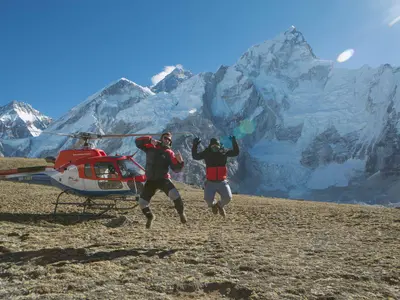
How to get to Everest Base Camp? Putting together a day-by-day itinerary.
Take a base itinerary and test every day against four things: how much higher you sleep, how far you walk, how you fly, and, if it matters to you, where you sleep. Change anything that doesn’t fit your requirements.
Trek Planning · Updated