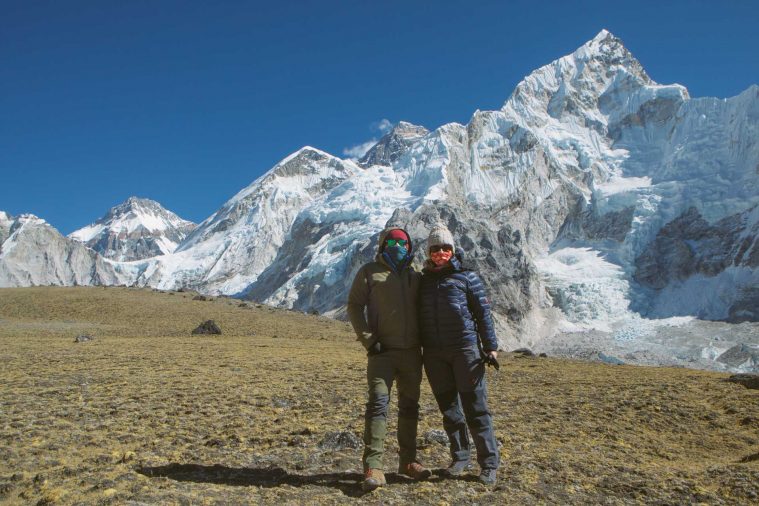
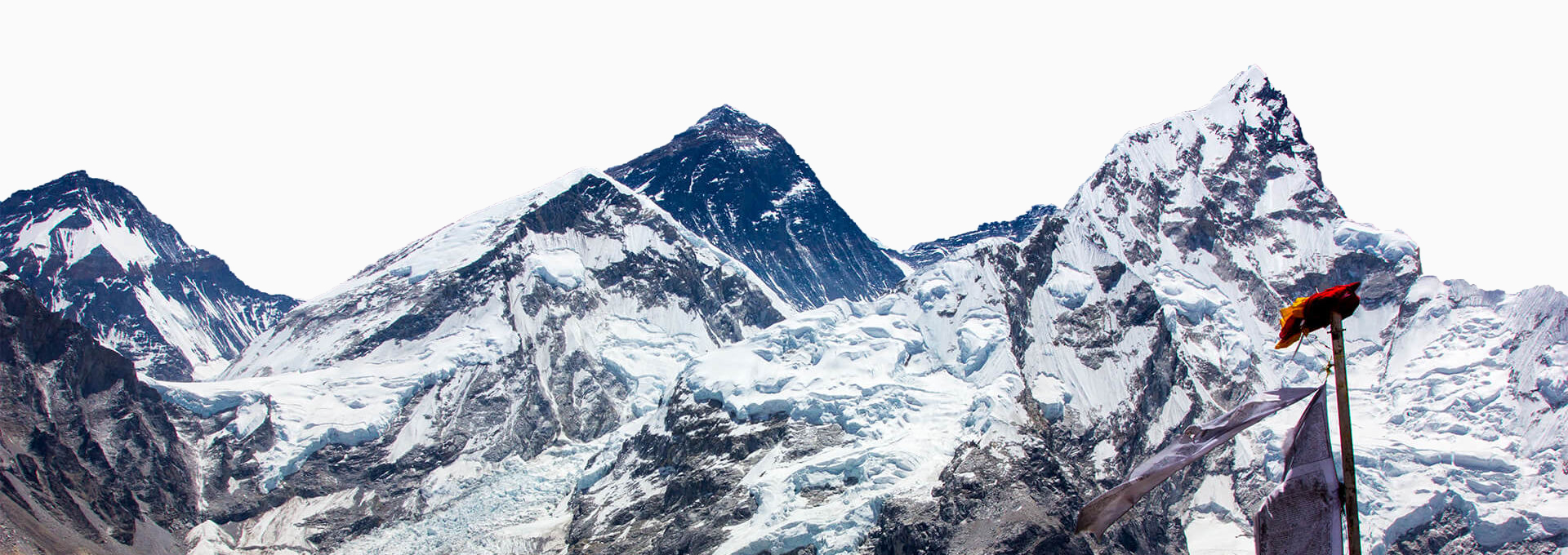
Everest trips come in four kinds: heli tours, short heli treks, classic treks and high pass circuits. The right one is decided first by the days you have, second by how high you are willing to sleep, and third by the pace you can hold. Your tolerance for uncertainty, the lodges you want and what you want to see settle the rest.
| Heli tours | Short heli treks | Classic treks | High pass circuits | |
|---|---|---|---|---|
| Examples | 1-day heli tour to EBC, Kala Patthar or Gokyo | Hotel Everest View, Tengboche and Namche Bazaar heli treks | Everest Base Camp Trek, EBC Heli Trek, Gokyo Lakes Trek | Everest Three Passes, EBC and Gokyo via Cho La, Gokyo and Renjo La |
| Highest night | None | Below 4,000 m | 5,164 m | 5,164 m |
| Largest one-night gain above 3,000 m | None | 440 m | 590 m | 600 m |
| Days | Half a day to 2 days | 4 to 6 days | 10 to 13 days | 13 to 19 days |
| Total walking distance | None | 25 to 50 km | 45 to 65 km with heli return, 90 to 130 km without | 130 km or more |
| Average walking day | None | 4 to 5 hrs, 7 to 9 km | 5 to 6 hrs, 8 to 10 km | 6 to 7 hrs, 10 to 12 km |
| Longest walking day | None | 7 hrs, 10.5 km | 8 hrs, 19 km downhill if walking out | 8 to 10 hrs over a high mountain pass |
| Uncertainty factors | Flights | Flights | Flights, trail conditions, altitude illnesses, long days | All of those, plus a high pass |
This trek comparison describes the base itineraries. With HoneyGuide, you can tailor your trip to suit your pacing and safety requirements. We have refrained from using the generic difficulty ratings of easy, moderate and difficult, because such labels hide more than they help.
Why does sleeping altitude decide which Everest trek fits?
Because altitude sickness is directly correlated with how high you sleep, not how high you climb. In a 1990 BMJ study of 466 climbers in four Swiss huts, Maggiorini and colleagues found acute mountain sickness (AMS) in 9 percent at 2,850 m, 34 percent at 3,650 m and 53 percent at 4,559 m. On this trail, Hackett, Rennie and Levine recorded AMS in 53 percent of 278 unacclimatized trekkers at Pheriche in 1976.
So the four kinds of trip are really four ceilings, from no night at altitude at all to 5,164 m at Gorakshep, and the highest night is the first number to settle.
The ceiling has two parts. How high you are willing to sleep is a preference. How high you can safely sleep is a medical question, and for some conditions the safe ceiling sits below the top of a trek however fit you are. A past episode of altitude illness changes the route too, toward a slower ascent than the standard one.
Does being over 50 or 60 rule out the higher treks?
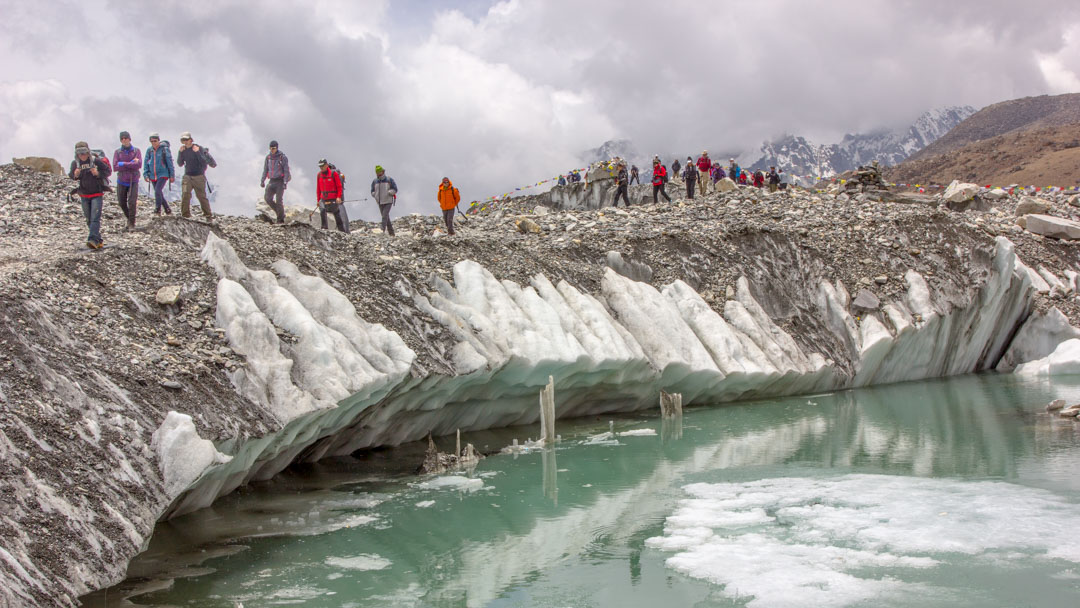
No. In studies of trekkers in Nepal, older age either lowered the risk of altitude sickness or made no difference. In a 2004 High Altitude Medicine & Biology study of trekkers bound for the 5,400 m Thorong La on the Annapurna Circuit, Gaillard and colleagues found that those over 55 were 2.6 times less likely to get AMS than those under 25, and that training status made no difference. McDevitt and colleagues repeated the survey in 2010 and again named younger age as a risk factor (Wilderness & Environmental Medicine, 2014). A 2018 meta-analysis of 18 studies in Military Medical Research found no significant link either way.
This doesn’t necessarily mean that age protects you against AMS, but that older trekkers tend to have a more conservative ascent profile.
What age does change is the medical file. In a 2022 survey of 350 trekkers on the Everest trail, mostly at Tengboche, 45 percent had a pre-existing condition, mostly orthopedic or cardiovascular. Keyes and colleagues surveyed 670 trekkers at Lukla for a 2016 Journal of Travel Medicine paper and found 33 percent with a pre-existing condition, and those over 50 about twice as likely to be taking medication. At 60, the question moves from your legs to your prescriptions. It is also why HoneyGuide’s Altitude-Aware Pre-Screening comes before routes, deposits or a guide are fixed. Medications sit on its checklist alongside a past HAPE, and the answers change the route rather than the paperwork.
The other thing age tests is the descent. Walking out from Gorakshep to Lukla drops about 2,300 m in three to four days, including a 19 km downhill day. That is where orthopedic problems tend to show, and it is the part of a classic trek a helicopter can remove. Alternatively, it is possible to reduce the distance as we did for Ishita during her Everest Base Camp trek in June 2023. In her review, she describes her group as “senior citizens in late 60 and early 70 with knee issues” who made it to Base Camp without any issues as they walked at their own pace.
How do your days and your pace narrow the choice?
The ascent rate sets a floor you cannot compress, so under a week rules out sleeping above 4,000 m, and only the descent can be shortened. Above 3,000 m, the Wilderness Medical Society’s 2024 guidelines cap sleeping gain at about 500 m a night with a rest day every third or fourth day. From Lukla at 2,860 m to Gorakshep at 5,164 m, that works out to eight days of walking up. With under a week, the realistic choices are the shorter alternatives to the EBC trek.
Standard itineraries sometimes go over that line, because lodges sit where they sit. In HoneyGuide’s base Everest Base Camp itinerary, the big step is Deboche to Dingboche, a 590 m gain, which is why the next day is a rest day at Dingboche. Two edits remove it. Sleeping at Pheriche instead cuts the gain to 510 m. Adding a night at Pangboche, 3,950 m, with a day walk to Ama Dablam Base Camp at 4,600 m, splits the step in two.
Walking speed in the Khumbu runs 1 to 3 km an hour, and days are planned to end by 4 pm, at least an hour before sunset. This means that the total distance you can plan to cover in a day averages around 12 km.
How much uncertainty can you live with on an Everest trek?
Every Everest trip carries flight risk, every walking trip adds health and trail risk, and every circuit adds a pass, so your tolerance for plans changing narrows the choice as much as altitude or days.
Köhler and colleagues interviewed 366 trekkers on the Everest Base Camp trek for a 2022 paper in the International Journal of Environmental Research and Public Health, and 40.5 percent had at least one medical incident during the trip, almost half of them AMS. Stomach illness comes next: of 479 inpatients treated in the Everest region from 1996 to 2011, 45.5 percent had altitude sickness and 10.4 percent acute gastroenteritis.
Every trip in this post begins and ends with a flight to Lukla, and cloud or crosswind can hold those flights for a morning or for days. Winter snow changes the passes rather than shutting them on a date. Trekkers on the TripAdvisor Nepal forum report crossing Cho La on December 25 and January 3. They also report sheet ice near the top, closed lodges at Thagnak, and snowed-in rest days before the Ngozumpa glacier.
The higher and longer the trip, the more of its itinerary is a forecast rather than a schedule. So if you are on a tight schedule or just don’t like uncertainty all that much, you might want to stick to heli tours or short heli treks.
Everest Base Camp, Gokyo Lakes, or both via Cho La?
Choose Everest Base Camp if the goal is the Base Camp rock and the Kala Patthar sunrise, Gokyo if you want the stronger Everest panorama from a lower top night, and both via Cho La if you have 15 days and will accept one icy pass.
| Everest Base Camp Trek | Gokyo Lakes Trek | EBC and Gokyo via Cho La | |
|---|---|---|---|
| Duration | 12N/13D | 10N/11D | 14N/15D |
| Highest night | 5,164 m, Gorakshep | 4,790 m, Gokyo | 5,164 m, Gorakshep |
| High point | Kala Patthar, 5,644 m | Gokyo Ri, 5,357 m | Kala Patthar, 5,644 m |
| Main trade-off | Busiest trail in the region, retraces the valley | Misses Base Camp and Kala Patthar | Cho La can be icy and slow |
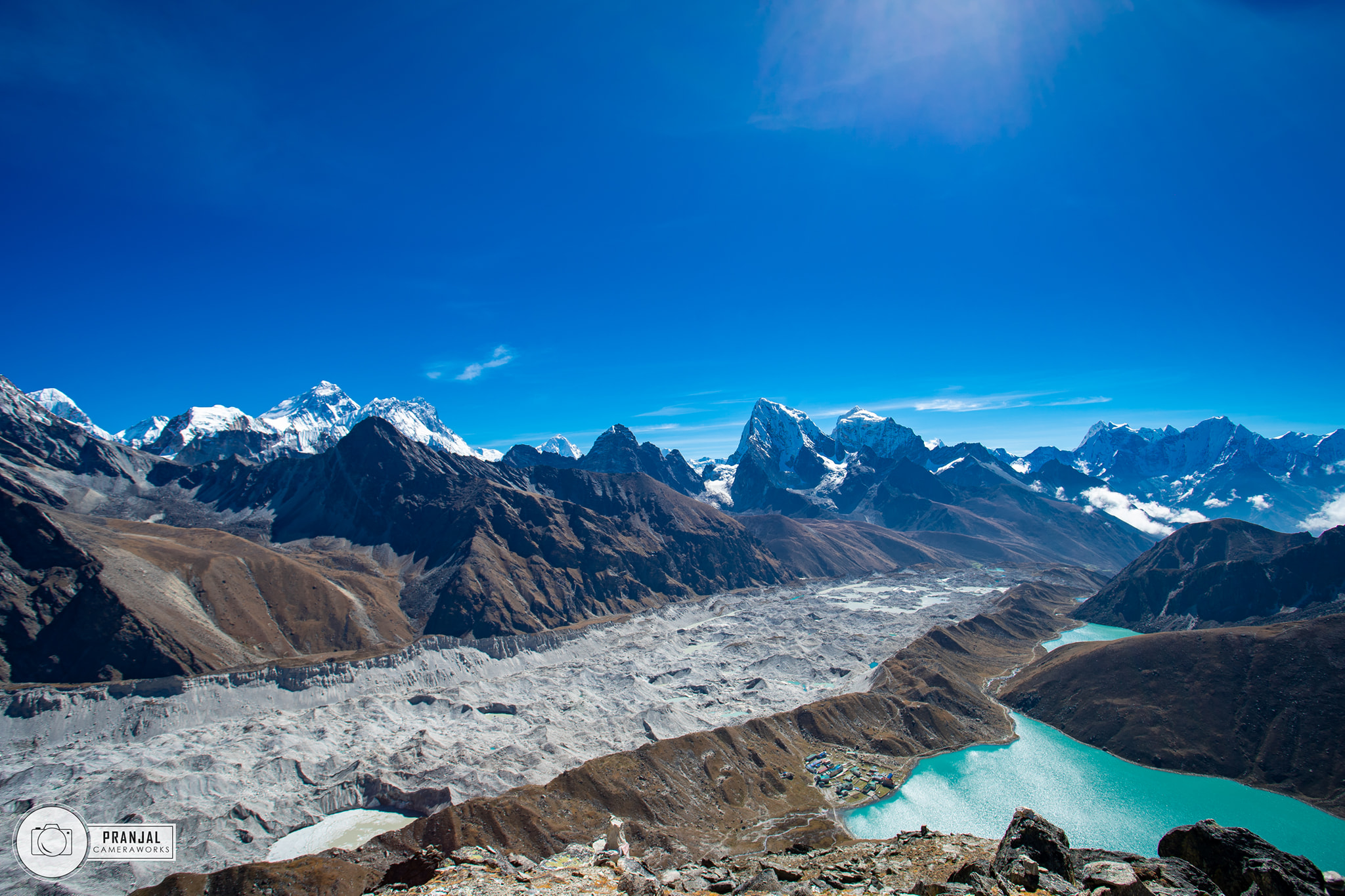
Gokyo’s case is altitude and quiet: its top night is 374 m lower, and Gokyo Ri looks at Everest, Lhotse, Makalu and Cho Oyu at once. However, the Base Camp side gives you more to do on short acclimatization days, with monasteries, schools and working villages, where the Gokyo valley is mostly wilderness and lodge clusters.
Alternatively, there are other creative ways to check off both EBC and Gokyo Lakes. For example, a HoneyGuide traveler reviewing an April 2023 trek on TripAdvisor had a plan that included an “overnight at Everest View hotel, helicopter pickup from Gorakshep,” with a stop at Gokyo on the way to Lukla. That is Base Camp on foot and Gokyo from the air, one of several Everest heli trek options built on the same idea.
Should you walk back from Base Camp or fly out?
Fly out if time or your knees matter more to you than the fare. The EBC Heli Trek, 9N/10D, walks the same route up as the Everest Base Camp Trek, 12N/13D, then flies from Gorakshep. That removes 3 days and the long downhill days.
It changes nothing on the way up. Every acclimatization night stays.
What can you see of Everest without sleeping above 4,000 m?
Most of the famous views. What you give up is what can only be reached on foot: the Base Camp rock and the Khumbu glacier from ground level.
The Hotel Everest View Heli Trek, 5N/6D, spends two nights at 3,880 m with Everest, Lhotse and Ama Dablam from the room. The Tengboche Heli Trek, 5N/6D, sleeps beside the monastery at 3,860 m. The Namche Bazaar Heli Trek, 4N/5D, sleeps no higher than 3,440 m. Each ends with a flyover of Base Camp, and each can add a landing on Kala Patthar at 5,644 m for the classic close-up.
Helicopter tours in the Everest region do the same in a morning from Kathmandu: about 4 hours, with breakfast at Hotel Everest View.
How far up can you sleep in a premium lodge?
To Dingboche on the Everest Base Camp route and to Namche on the Gokyo route.
| Premium | Mid-range | Teahouse only | |
|---|---|---|---|
| Everest Base Camp Trek | Lukla to Dingboche | Pheriche | Lobuche, Gorakshep |
| Gokyo Lakes Trek | Lukla to Namche | Dole to Gokyo | None |
| Tengboche Heli Trek | Lukla to Namche, Tengboche | Khumjung | None |
| Hotel Everest View and Namche Bazaar heli treks | Throughout | None | None |
A comfort-first traveler therefore has three real options. A short heli trek stays in premium or mid-range lodges throughout. The Gokyo Lakes Trek reaches 4,790 m without a single teahouse night. The Everest Base Camp Trek asks for two teahouse nights, at Lobuche and Gorakshep, in exchange for Base Camp itself.
With creative use of helicopters, HoneyGuide routinely builds treks around a comfort-first brief. Once you are clear about what you want, we should be able to find a trek that fits.

Sources
- Luks AM, Beidleman BA, Freer L, et al. Wilderness Medical Society Clinical Practice Guidelines for the Prevention, Diagnosis, and Treatment of Acute Altitude Illness: 2024 Update. Wilderness & Environmental Medicine 2024;35(1 suppl):2S-19S. The ascent-rate ceiling that separates the four kinds of trip.
- Maggiorini M, Bühler B, Walter M, Oelz O. Prevalence of acute mountain sickness in the Swiss Alps. BMJ1990;301:853-855. The clearest measurement of AMS rising with sleeping altitude.
- Gaillard S, Dellasanta P, Loutan L, Kayser B. Awareness, prevalence, medication use, and risk factors of acute mountain sickness in tourists trekking around the Annapurnas in Nepal: a 12-year follow-up. High Altitude Medicine & Biology 2004. The age finding in section 2.
- Keyes LE, Mather L, Duke C, et al. Older age, chronic medical conditions and polypharmacy in Himalayan trekkers in Nepal. Journal of Travel Medicine 2016;23(6):taw052. What trekkers over 50 carry up the Base Camp trail.
- Köhler et al. Companion Rescue and Risk Management of Trekkers on the Everest Trek, Solo Khumbu Region, Nepal. International Journal of Environmental Research and Public Health 2022. How often health changes the plan on this trail.