






Stories & Culture
Guru Padmasambhava
Guru Padmasambhava is a story recorded around Namche Bazaar, Sanasa, Pangboche.
- Category
- Stories & Culture
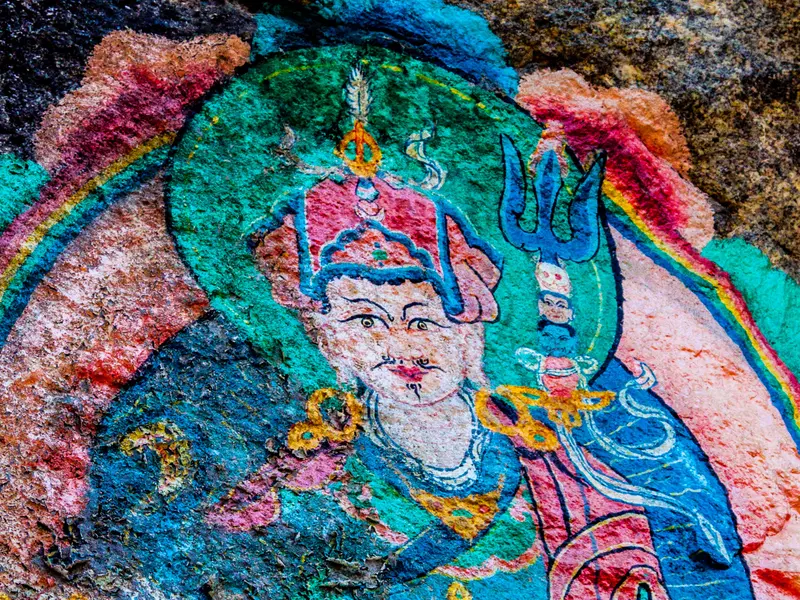
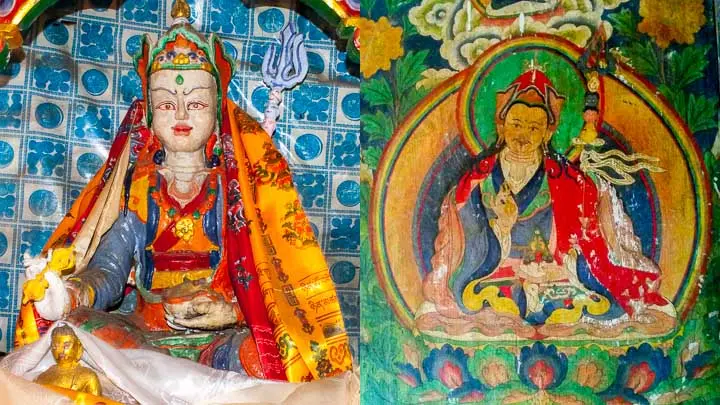
As a person, Padmasambhava was an Indian yogi who helped in the construction of Samye Monastery in Tibet and translated many Buddhist doctrines from Sanskrit to Tibetan. As a legend, he was the lotus born (that is what the name Padmasambhava means) who couldn't be burnt, who could cure epidemics, who pacified demons and who was single handedly responsible for making Buddhism the dominant religion in Tibet. Whatever the facts and fictions, the one thing that is true today, is that he is immensely revered by all followers of Buddhism and landmarks associated with his travels are found throughout the stretch of the Himalayas and Tibet. So deep is the reverence he inspires today, that for many, even the Buddha himself is secondary to this great figure. Historically, the time of Padmasambhava was a time of power shift in Tibet from the western province of Zhangzhung centered at Mount Kailash to the eastern kingdom of the Yarlung Kings centered at Lhasa. While political annexation was accomplished about 645 AD at least a century before the time of the Guru, there was very little cultural assimilation. Zhangzhung was also the power centre of the ancient shamanistic religion of Tibet, Bon, while Lhasa was already taking its baby steps towards Buddhism. It was in this backdrop that Guru Padmasambhava was invited by the Tibetan Emperor Trisong Detsen around 760 AD. The Emperor's declaration of Buddhism as the state religion of Tibet surely went a long way in establishing Buddhism and without doubt Guru Padmasambhava's missionary work took it even further. Perhaps the demons the Guru is said to have fought were the local animistic divinities of the Bon religion. And the pacification perhaps refers to the act of bringing these local divinities under the philosophical framework of Buddhism. This fusion of local divinities with an overarching philosophy can still be seen across different groups in the Himalayas where many Buddhists still worship mountains and streams. It wasn't however until the 11th century that Buddhism became the dominant religion of Tibet and the Himalayas. Perhaps, the idea that is Guru Padmasambhava is the distilled essence of all these political and religious forces which currently shape the cultural landscape of the Himalayas. And as an idea, he is capable of transcending the physical to be the legend that he is today.